
Videos, Podcasts, Articles
for All things Mind-Body Healing
Tonia Winchester Coaching
Need Help? Call or text us at (778) 743-1277
POSTS, PODCASTS, VIDEOS

How Often Do I Need Mistletoe Injections?
How Often Do I Need Mistletoe Injections?
If you’re living with the grinding pain and stiffness of osteoarthritis, you’ve probably tried everything to get some relief. When patients walk into my practice at Knead in Nanaimo, they’re often looking for something that goes beyond just masking the symptoms.
That’s where mistletoe injections for osteoarthritis come in. It’s an incredible, body-centered therapy that works with your immune system to target and potentially reverse joint degeneration. One of the most common questions I get is: How often do I actually need these injections?
The short answer is that there’s no one-size-fits-all schedule. We don’t just hand you a calendar and tell you to show up every Tuesday for the rest of your life. The goal isn't to get to the end of an arbitrary protocol.
Instead, we let your unique body, your immune response, and your joint health dictate the pace. Here’s exactly how we break down the timeline and frequency in my practice.
The Initial Litmus Test: The First Four Weeks
Every journey with mistletoe therapy starts with a foundational step. I find what works best is starting with four injections, done weekly over four consecutive weeks. Think of this initial month as a diagnostic litmus test. It’s a starting place to see how your system responds.
If by the end of those four weeks we see absolutely no glimmers of improvement, I’ll stop and question two things.
I’ll double-check if our original diagnosis of osteoarthritis is 100% correct.
We’ll evaluate whether mistletoe is actually the right therapy for you.
Seeing zero response is very rare, but it’s an important safety valve in my practice. Most patients need more than four treatments for longer-lasting relief. Depending on the severity, progression, intensity, and duration of what you’ve been suffering with, you’ll likely need up to ten treatments, and sometimes more, to establish a deep foundation of healing.
But there’s a major caveat to this weekly rhythm: mistletoe is a reactive therapy. We’re explicitly expecting to trigger an immune activation right at the injection sites over your joint we're treating.
The mistletoe is injected several times into the top layers of your skin—either subcutaneously or intradermally—and a reaction normally arises within 48 hours.
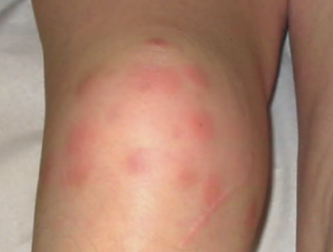
The size and intensity of this reaction, which feels like a little hive, a bee sting, or a mosquito bite, tells us everything. If we see nothing at all, we haven’t challenged your immune system enough. But if the spots all converge into a red, raised, very warm, and extremely itchy lesion greater than five centimeters in diameter, we know we’ve pushed too hard.
Because we strictly respect and trust what your body is showing us, if a reaction is still fully present when your next appointment rolls around, we’ll pause. In fact, our clinic will wave the late cancellation fee for this appointment type because we can't rush your immune system.
Finding Your Sweet Spot and Navigating Maintenance
Finding the perfect dose is an endurance race, not a sprint. Your immune system naturally learns to tolerate the medicine, so part of the therapy involves titrating your dose upward. I usually start patients at a gentle 2 mg per treatment, and I’ve gone as high as 80 mg. Interestingly, age plays a fascinating role here. One of my mentors suggested that the older a person is, the higher the dose they’ll tolerate, and I’ve certainly seen that to be true in my own practice.
Getting the dose right takes patience. When I was first introducing these injections, I followed a protocol that jumped a patient from 1 mg to 5 mg, and then straight to 10 mg to treat osteoarthritis in her wrists. The 10 mg was way too much, too soon. She was red, swollen, and terribly itchy for almost ten days, and had to resort to antihistamines.
It was a massive lesson for me to titrate much more slowly. On the flip side, I treated a woman who’d been suffering for a long time with degeneration in multiple joints. We started slowly, and it wasn’t until we hit 50 mg and beyond that she finally saw those glimmers of improvement, like regaining the range of motion needed to simply turn her head from side to side.
Shifting the Schedule Based on Your Success
We keep up the weekly injections until you come in for your follow-up visit and I ask, "How did the week go?" and you can look me in the eye and say, "It went pretty good!" That’s our green light that suggests your body is ready to start shifting the schedule.
At that point, we’ll space things out and suggest meeting in two weeks to see how your joint holds up over that timeframe.
Once you’ve experienced two or three "pretty good" two-week intervals, we’ll extend the time between appointments even further, to three or four weeks. When you reach a stable state, your maintenance phase will generally follow one of two paths based on your preference:
The Monthly Rhythm: You come in once a month to keep the joint stable and maintain your progress.
The Pulsed Approach: You take a longer block of time completely off, say two months, and then come back in for a short succession of weekly treatments for one month to give your system a booster.
What True Stability Looks Like
When I talk about a patient being stable, I don’t just mean a minor dip on a pain scale.
To me, stability means
you have no pain in your normal daily experiences, and very little to no pain during your extraneous life circumstances—like going on special trips or tackling a beautiful hike.
you’ve got improved range of motion, like being able to get up and down off the floor with ease.
you’re getting better sleep because pain isn’t waking you up, and you have the physical endurance to do what you love.
We’re incredibly blessed to live in Nanaimo, surrounded by a gorgeous temperate rainforest on Vancouver Island with world-class forest hikes in every single direction.
I see so many patients whose knees and hips are keeping them trapped indoors. While those are the most common joints I work with, I’ve used mistletoe to treat wrists, thumbs, ankles, shoulders, and spines too.
Ultimately, these injections have incredible potential to help you avoid knee and hip replacement surgeries. I don’t just mean that patients subjectively choose to skip surgery because they feel better; I mean that on objective, medical imaging studies, they actually no longer qualify as candidates for surgery.
It's a bit mind-blowing to be honest!
Hearing happy updates from patients of them getting back out enjoying their lives will always delight me because I believe that health isn’t something we do just for the sake of it. It’s the vehicle that drives us to the things in life that light us up.
I also truly believe that healthy, happy people doing what they love contribute to a more peaceful world.
If you’re ready to see if mistletoe can get you back on the trails, let’s find your sweet spot together. Book your injection consult here).
(And if you're dealing with a different type of pain or limited mobility that is not rooted in osteoarthritis, but nerve or soft tissue, I talk about a different injection service I offer in this post).


I help every day folks
release the painful imprint of the past, Shift their perspectives, create healthy habits so they can Enjoy exceptional lives!
My clients are people stuck in their health or lives with burnout, insomnia , anxiety, or stress. After working with me they can calm their minds, sleep deeply, and find joy and energy again - all with out talk therapy or medications.
🧠💟💫
Mind-Body Healing & Coaching

Easily create and support new habits.

Lift your mood,
heart, mind
to feel good here and now.

Release and clear the pain of the past and go back into healing mode.
Helpful Books and Courses
Enjoy the benefits of a good night's rest.

Change your thinking to Change your
Health and life

Sleep Deeply.
Wake Rested.
Free Content (Also helpful!)

Over 200 articles on Health, healing, natural medicine (2013 - 2020)
More Posts, podcasts, videos on mind-body medicine.
(2021-current)

Where we turn little life moments into big life lessons.

Free guided visualization to release old negative emotions.

FOR SUPPORT ISSUES OR QUESTIONS, PLEASE EMAIL: vitality@toniawinchester.com
Copyright @2022 -2025 · Tonia Winchester · All Rights Reserved
This site is not a part of the Facebook website or Facebook Inc. Additionally, this site is NOT endorsed by Facebook in any way. FACEBOOK is a trademark of FACEBOOK, Inc.